Showing posts with label Research. Show all posts

Monday, October 27, 2014

World Language Corner

As teachers and speakers of world languages, we occasionally hear parents say, “My child doesn’t need to learn a second language. I prefer that s/he focus on the ‘real’ subjects like math and English.” Likewise, students sometimes ask, “Why do I have to learn another language? Everyone in the world speaks English!” 

Below, we share a few of the reasons why other language learning is beneficial, useful, enriching, and (we would say) even life saving. These excerpts come from the Middlebury College Interactive Languages program:

FIVE (totally objective) REASONS everyone should know at least two languages:

1)     Students who study a world language for just one year score an average of 38 points higher on the SATs. (Even cooler: Students who took four years of a world language showed scores that were more than a hundred points higher on average.)
2)    The National Institutes of Health discovered that people who speak more than one language are much better at multitasking, which means walking on your hands while chewing gum should be a breeze.)
3)    According to an MITstudy, people who know two or more languages earn an average of $128,000 more in their lifetimes.
4)    2012. The year that researchers at the University of Cambridge discovered that people who know two languages are nicer. According to the research, bilingual folks are better able to tolerate differences and find solutions to conflict.
5)    835 eleven-year olds were tested on their cognitive ability in Scotland in 1947. Between 2008 and 2010, those same people were retested in their seventies. Of the 835 case studies, 260 knew at least two languages. THOSE 260 PEOPLE TESTED SIGNIFICANTLY HIGHER IN COGNITIVE FUNCTION THAN THEIR SOLELY ENGLISH-SPEAKING PEERS.

People who know two or more languages can order dinner in another country without accidentally getting broiled squid. They can make friends with people from different cultures and countries. They can also ask for directions to the restroom and actually end up in the restroom. In our opinion, everyone should learn another language!

FIVE WAYS that being bilingual makes you smarter:

1)     In a Florida study, kids who knew two languages SCORED AN AVERAGE OF 23 TO 34 POINTS HIGHER on both math and language arts standardized tests than kids who only spoke one language.
2)    54% of PRESCHOOL AGE BILINGUAL CHILDREN ARE ABLE TO EASILY DISTINGUISH THE MEANINGS OF WORDS. Most children aren’t able to do this until elementary school.
3)    BABIES RAISED IN BILINGUAL HOMES demonstrated SUPERIOR COGNITIVE ABILITY – specifically the ability to seek new stimuli more quickly, as early as seven months old. (According to the National Academy of Sciences, that’s an early indicator of a high IQ.)
4)    People who know more than one language are able to PAY ATTENTION for 20% LONGER on average than their one-language-speaking friends.
5)    Bilingual people have .05 cubic millimeters more of gray matter in the parietal regions of their brains than those who speak only one language.

FIVE REASONS knowing a world language makes you more creative:

1)     People who know more than one language are better able to utilize a distinct area of the brain called Broca’s area. As infinite connections between words and language are made in the brain, these thinkers are able to better think creatively and abstractly.
2)    1, 596, 234 is the number of people who tuned in to the TedTalk by linguist Patricia Kuhl as she explained how bilingualism helped babies as young as six months old make use of sophisticated creative reasoning.
3)    A group of 60 bilingual students were studied alongside 60 of their one-language-speaking peers. The researchers found a noticeable difference in the level of detail and richness in descriptions by the bilingual student – proof that they thin more colorfully.
4)    DID YOU KNOW THAT IN JAPANESE, THERE ARE TWO WORDS FOR THE COLOR BLUE? One refers to lighter shades of blue and the other to darker one. Because different language vary so much in vocabulary, people who speak two languages are able to perceive things like color differently.
5)    45.4 MONTHS. Bilingual children showed a statistically significant increase in mathematical creativity (that’s code for thinking outside of the box) as early as 45.4 months. That’s less than four years old.

People who know two or more languages make our world more colorful. They can tell you about early Renaissance art and also pronounce the names of the artists correctly. They can speak with a flourish and cadence that sounds like a classic song.  In our opinion, people who speak more than one language are some of the most creative people in the world. 

PLEASE SHARE how knowing another language has changed or influenced your life. JUST e-mail your child’s language teacher – we would love to hear!

STAY TUNED for future posts.

Deborah Fugate
Middle School Spanish Teacher


Wednesday, January 29, 2014

iTeach, Therefore I Am

Several years ago I attended the California Association of Independent Schools (CAIS) Northern California Regional meeting. I attended a session on teaching animation in primary and middle schools with Barbara Cohen who, at the time, was Director of Technology with the Marin Country Day School.

Barbara Cohen
Barbara began her workshop with introductions and went out of her way to explain to all the other people in the room that she'd known me for a very long time. She added that I had taught her everything she knew about teaching video production with students.

I was a bit embarrassed about this introduction to the group. After all, the work I did with Barbara was at least 10 or 12 years earlier. We worked together on a project I created that taught students video production with VHS camcorders and linear video editing equipment. That process became obsolete long ago.

It occurs to me now that Barbara was really saying I had taught her an important lesson about the power of teaching with multimedia in the classroom. More specifically, I had taught her the value of engaging students in media production in the classroom.

Student video producers circa 1994
Classroom media production projects create an environment that promotes a deepening of student understanding of the content in their classes. Student media projects are also an integral part of student assessment in the modern classroom -- especially in 1:1 schools.

However, today students make their own videos on tablets and cell phones, and publish it for the world to see -- without the help (or even the request) of their teachers!

Which brings me to iTeach 2014.

At San Domenico School technology is a vital tool in the entire educational process. Teachers use it for their own personal productivity and for managing their educational resources and student grades and information. More importantly, because we are a 1:1 iPad school, we are engaing our students with technology every day. Having a powerful research and communication device stuffed in your backpack provides amazing access to information. These devices also include a variety of tools we now call Apps. Students use them to collect, analyze, and produce their own projects based on their research.

This is all fine, as long as everyone knows how to use these tools.

In a recent survey of San Domenico teachers, 82% said they publish course materials online using a variety of "cloud" resources including Moodle, Blogs, Google Sites and Drive, Box, Turnitin, and our Library web page. 93% of our teachers say they engage their students with digital tools in their curriculum 25% of the time or more in class. Almost 40% of our students are required to complete some sort of digital portfolio as part of our curriculum.

92% of our teachers say their comfort level with using technology in their classroom is 5 or higher on a scale of 1-10. 68% said they were a 7 or higher. On the same scale, 77% of our teachers answered 7 or higher when asked how important it is to continue to expand the way they integrate technology in their curriculum.

When teachers were asked to name the most important areas for us to focus when thinking about ways to improve technology integration in our curriculum they answered:

   "More professional development"
   "Technology specific curriculum development"
   "Time to collaborate with my colleagues"

Whether it be regular faculty meetings, one of our school level technology committees, outside conferences and workshops, or the creation and delivery of  iTeach 2014, our teachers want to learn from and teach their colleagues what they know about teaching with technology.

Sharing what you know, and being willing to learn from others is certainly a hallmark of teaching and the teacher very often becomes the student when it comes to technology. Now, with  iTeach 2014, San Domenico teachers and other leading technology using educators come together to teach and to learn about using technology to enhance student learning.

Thank you Barbara for reminding me that engaging students with technology on a regular basis is a powerful way to deepen their learning. I look forward to learning with you at iTeach 2014 this summer.

Brad Lakritz
Director of Technology


Saturday, October 19, 2013

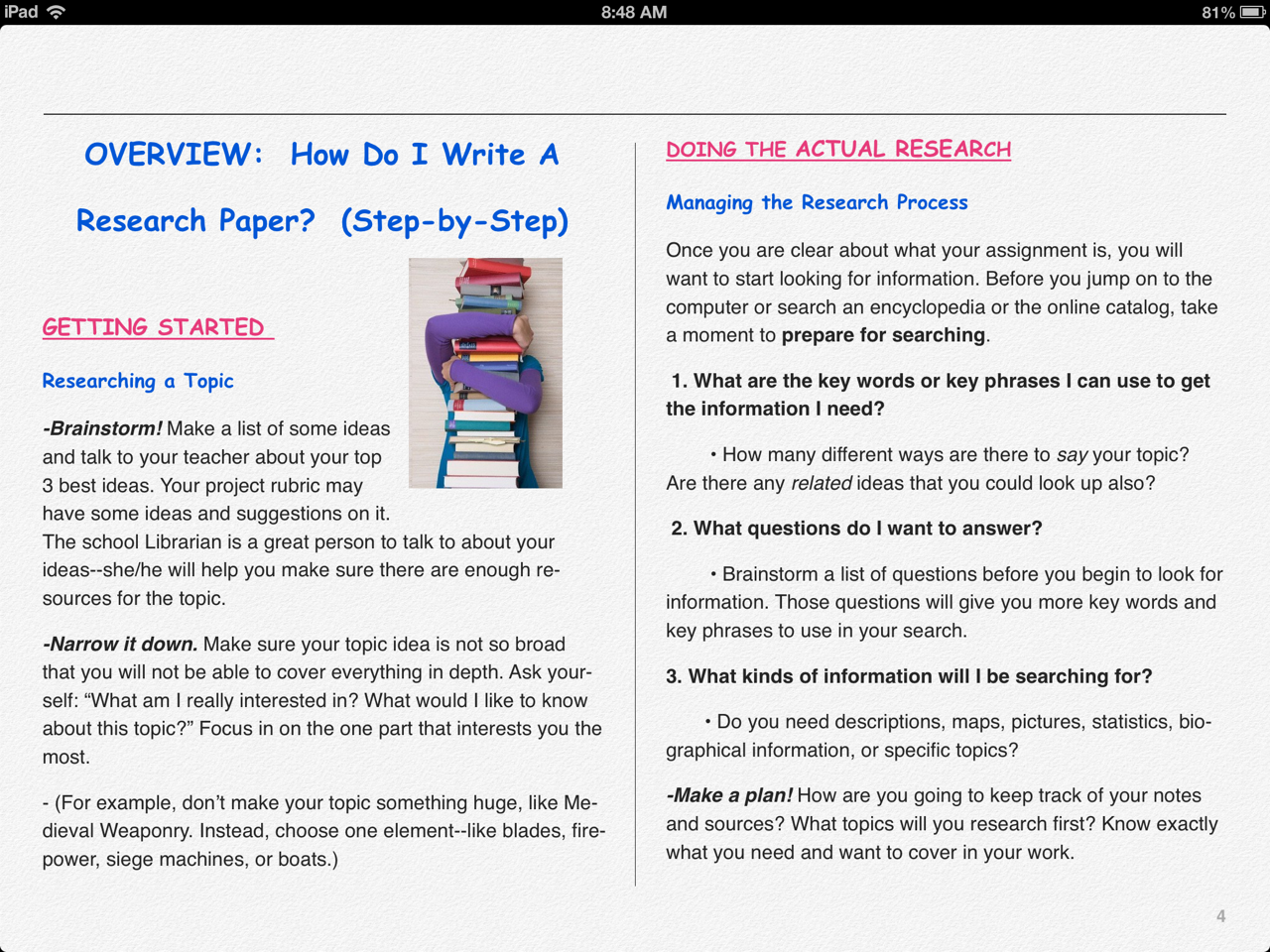
Research and Non-Fiction Writing Guide e-Book

The San Domenico Middle School Humanities Department discussed methods for standardizing the way students learn to do research, write, and cite sources in their research papers. Our department assigns the bulk of these types of projects so we took the lead in creating a guidebook both students and teachers could use as an easy reference for all of their research assignments.

We decided to make our guide available as an e-Book on the iPad -- easy to access and impossible to lose! 

I used iBooks Author as the app and created the guide on my laptop. Students download the e-Book from a link to the file stored in Box. On their iPad students simply select the file and click "open in iBooks" to properly display the book.

The Research and Non-Fiction Writing Guide includes chapters on works cited, in-text citations, making an outline, working with notes, formal writing conventions, and many other pertinent topics. 

The guide is based on MLA standards and navigation is easy on the student-friendly pages.

Our students find the research guide quite useful and are very enthusiastic about applying it in their work. It's so rewarding to give them something that is both relevant and helpful.

Our hope is that other teachers will find this e-Book equally useful for their own student papers, projects, and other assignments. Take a look at our guide by going here.


San Domenico Middle School

History Teacher, Humanities Lead Teacher, Study Skills Coordinator